Serving Los Angeles | Orange | Riverside | San Bernardino

Questions about indoor air quality? Call (951) 574-1698 or send us a message and a real technician will get back to you.

Dust that keeps coming back, a musty smell, or allergy symptoms that flare up indoors usually point to a specific, fixable cause in your HVAC system, not something a store-bought air freshener can solve. AmeriWest starts with a whole-home air quality assessment and recommends the right combination of duct cleaning, filtration, humidity control, or UV treatment for your actual air. We serve homes and businesses across Orange County, Los Angeles County, Riverside County, and San Bernardino County, including Irvine, Riverside, Corona, Anaheim, Ontario, Huntington Beach, and more than 40 other cities.
Here’s how we get from a stuffy house to noticeably cleaner air.
Air Quality Assessment
We inspect your ductwork, filtration, and humidity levels.
Custom Recommendation
You get a specific plan, not a one-size-fits-all upsell.
Professional Installation
We install the solution and verify the improvement.
Poor indoor air quality is often traced back to leaky ductwork pulling in dust and allergens, a dirty filter that can’t keep up, or humidity that’s too high or too low for comfort. Fixing the actual cause works better than covering the symptom.
Every indoor air quality recommendation we make is based on what we find during the assessment, not a standard package. Some homes need duct sealing, others need filtration, and many need a combination of both.
If allergy symptoms, dust, or odors are worse indoors than outdoors, your HVAC system is likely the cause. Free assessments across all four counties we serve.
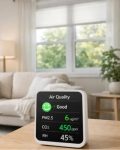
Indoor air quality problems have specific causes, and our process is built to find them instead of guessing at a fix.



Ameriwest Home Services proudly partners with Greensky, Optimus Financing, and Service Finance to provide flexible HVAC financing options, ensuring you get the expert service you need with payment plans that suit your budget

Not automatically. Inspection of HVAC conditions, humidity checks and pollutant sampling are different scopes. Ask which observations or measurements are included, who performs them and how the findings will be reported. Confirm the assessment scope before booking rather than assuming a whole-home label includes testing for every pollutant or a medical explanation of personal symptoms.
Indoor activity, outdoor entry, filter fit, air distribution and other property conditions can contribute to dust. A clean filter does not identify which source matters most. Review ductwork assessment and filtration assessment as possible next steps only when the findings justify them, rather than assuming leaking ducts or one product is always the answer.
No. An odor does not prove the source, location or identity of contamination. Moisture and other property conditions may need evaluation beyond HVAC equipment. Ask which finding supports the proposed next step. Use the air quality service overview to identify relevant services, and confirm whether any specialized inspection or remediation is separate from the HVAC visit.
It is useful to understand the concern and system first. A product should have a defined role, and the exact model matters. Filtration and purification do not remove every source or pollutant. Compare purifier assessment with UV service only after the proposed purpose and compatibility are clear.
No. Avoid a promised personal health outcome from an equipment installation. A practical plan can address applicable air or system conditions, but it should explain what the selected product is documented to do. Review the available service options and keep personal health questions separate from a contractor’s equipment recommendation.
No. Humidification addresses a particular moisture-related condition and needs a suitability review. It does not replace source control, particle filtration, equipment repair or correction of unwanted moisture. Review humidifier service and ventilation fan options as distinct choices rather than treating either as a universal air quality solution.
No. For a CO alarm, get outside immediately and call 911. Suspected gas leakage requires leaving and contacting the gas utility from a safe location, with 911 for immediate danger. Do not rely on a purifier or filter for those hazards. After emergency clearance, heating equipment assessment may be a separate next step.
Ask what was observed or measured before the work and what can be checked afterward. Equipment operation, airflow findings and pollutant measurements are different kinds of evidence. Keep the records and model-specific care instructions. Review cooling care and membership coverage so any ongoing service matches the installed equipment and agreed scope.
Explore related products and local service: