Serving Los Angeles | Orange | Riverside | San Bernardino

Questions about uv germicidal lamps? Call (951) 574-1698 or send us a message and a real technician will get back to you.

Mold and bacteria can grow inside dark, moist ductwork and evaporator coils, recirculating through your home every time the system runs. A UV germicidal lamp installed directly in your ductwork uses ultraviolet light to neutralize those contaminants at the source, continuously, with no chemicals involved. We serve homes and businesses across Orange County, Los Angeles County, Riverside County, and San Bernardino County, including Irvine, Riverside, Corona, Anaheim, Ontario, Huntington Beach, and more than 40 other cities.
Here’s how a UV germicidal lamp gets installed into your existing HVAC system.
System Assessment
We check your ductwork and coil for the ideal lamp placement.
Professional Installation
The UV lamp is installed to treat air as it passes through.
Verification
We confirm proper operation before we consider the job done.
UV germicidal lamps work continuously while your HVAC system runs, targeting mold, bacteria, and viruses on the evaporator coil and in the passing airflow without adding any chemicals to your home’s air.
This is one of the most effective upgrades for homes dealing with a persistent musty smell, visible mold on the coil, or household members with mold sensitivities.
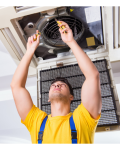
If your system smells musty every time it kicks on, mold or bacteria in the ductwork is a likely cause. Assessments across all four counties we serve.
A UV germicidal lamp only works if it’s placed and powered correctly. Here’s what our installation covers.



Ameriwest Home Services proudly partners with Greensky, Optimus Financing, and Service Finance to provide flexible HVAC financing options, ensuring you get the expert service you need with payment plans that suit your budget

UV germicidal lamps produce UV-C energy inside an enclosed portion of compatible HVAC equipment. They are commonly positioned to illuminate the evaporator coil and nearby surfaces where moisture can support microbial growth. They do not capture dust or replace ventilation and filtration. A complete plan may combine UV-C with BioGuard powered filter or a Dust Free air purifier after an indoor-air-quality assessment.
No. An air filter captures particles in the airstream, while UV-C treats illuminated surfaces or air within a limited section of the equipment. Continue using the filter specified for your system. AmeriWest can compare indoor air quality services, powered filtration, UV-C, and ductwork repair and cleaning based on the actual problem.
UV-C equipment should not be presented as a treatment for allergies, asthma, or another medical condition. It may be one part of an environmental-control plan, but particle triggers often require appropriate filtration, source control, and cleaning. Review air-quality solutions and consult a qualified healthcare professional for medical guidance.
Placement depends on the equipment and objective. Coil-mounted UV lamps are generally positioned to illuminate the indoor coil and drain-pan area; in-duct systems require different sizing and exposure calculations. A technician should verify clearance, wiring, access, materials, and safe enclosure before installation. Use contact AmeriWest to request an equipment evaluation.
Lamp output declines over time even when the bulb still appears illuminated. The correct interval depends on the manufacturer, model, operating schedule, and installation conditions. Follow the documented replacement schedule and keep the lamp and illuminated surfaces accessible for service. AmeriWest’s maintenance membership may help homeowners plan recurring HVAC maintenance, but lamp coverage should be confirmed.
Start with contact AmeriWest and provide the HVAC model, equipment location, filter type, and the indoor-air concern you want to address. AmeriWest can inspect compatibility, explain lamp placement and maintenance, and compare the option with other indoor air quality services.
They solve different problems. A whole-home humidifier adds moisture when indoor air is too dry, while UV-C is used for targeted microbial control inside HVAC equipment. Humidity should be measured and controlled because excess moisture can support condensation and microbial growth. An assessment should determine whether either system is appropriate.
They can be used safely when correctly selected, enclosed, labeled, and installed so occupants and service personnel are not exposed directly. UV-C can harm eyes and skin and can degrade some materials. Professional installation should include safe mounting, electrical controls, access precautions, and operating instructions. Related system checks can be coordinated with AC maintenance or heating maintenance.
Pair this with: