Serving Los Angeles | Orange | Riverside | San Bernardino

Questions about whole house fans? Call (951) 574-1698 or send us a message and a real technician will get back to you.
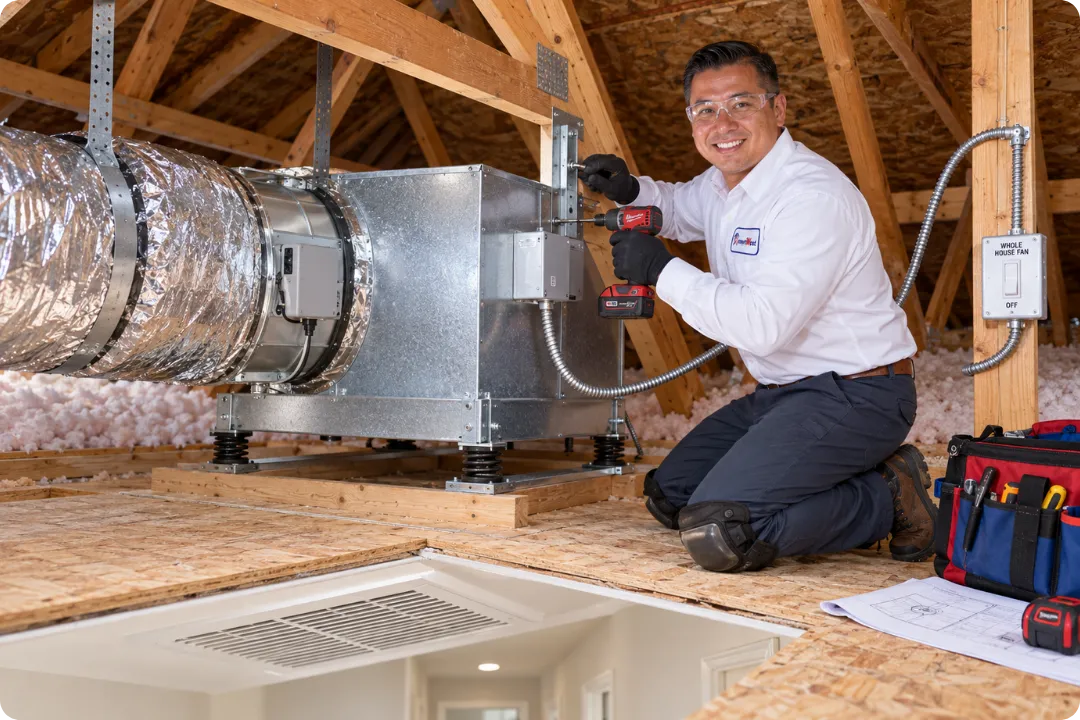
On mild Southern California evenings, a whole house fan pulls cool outside air through open windows and pushes hot indoor air out through the attic, dropping indoor temperatures in minutes and cutting AC runtime the rest of the night. AmeriWest installs whole house fans sized to your home’s square footage. We serve homes and businesses across Orange County, Los Angeles County, Riverside County, and San Bernardino County, including Irvine, Riverside, Corona, Anaheim, Ontario, Huntington Beach, and more than 40 other cities.
Here’s what to expect once you call or book online, from sizing to the first night you run it.
Home Assessment
We measure your square footage and check your attic ventilation.
Professional Installation
The fan is installed in your ceiling with proper attic venting.
Test And Walkthrough
We test airflow and show you exactly when and how to run it.
A correctly sized whole house fan can replace several hours of AC runtime on mild evenings, and most installations are completed in a single day, including the attic ventilation work needed to exhaust the air the fan pulls through your home.
Attic ventilation matters as much as the fan itself. If your attic can’t exhaust air fast enough, a whole house fan can pull musty attic air back into your living space. We check and size vent area as part of every installation, not as an upsell later.

The cooler it is outside at night, the more a whole house fan saves you. Free assessments across all four counties we serve.

An undersized fan barely cools a room, and an oversized one without enough attic venting causes problems of its own. Our process avoids both.



Ameriwest Home Services proudly partners with Greensky, Optimus Financing, and Service Finance to provide flexible HVAC financing options, ensuring you get the expert service you need with payment plans that suit your budget

Use contact AmeriWest and provide the home size, number of stories, attic access, roof/attic vent information, cooling concerns, and any combustion appliances or fireplaces. AmeriWest can evaluate capacity, intake and exhaust paths, noise goals, electrical needs, and how the fan will complement existing air-conditioning services.
They require careful evaluation because a large exhaust fan changes pressure inside the home. Naturally drafted water heaters, furnaces, fireplaces, and other combustion equipment can create backdrafting concerns. A qualified installer should identify appliances, confirm safe operating conditions, and explain when the fan must not run. Related heating equipment can be reviewed through heating maintenance.
Usually not in every condition. It can reduce indoor heat when outdoor air is cooler, but it cannot mechanically cool air below outdoor temperature. Most Southern California homes still need AC during hot periods. Keep the cooling system reliable with AC maintenance and use AC repair when a mechanical fault is causing poor cooling.
No. Because the fan intentionally brings outdoor air inside, it should remain off when smoke, high particle levels, odors, excessive humidity, or other contaminants make outdoor air unsuitable. Close windows and use appropriately selected filtration. AmeriWest can explain indoor air quality services, including a BioGuard powered filter or Dust Free air purifier, for HVAC-based particle control.
Yes. Selected windows must be open enough to create safe, predictable intake paths. Running a whole-house fan with windows closed can create excessive negative pressure and may increase backdrafting risk around combustion equipment. The installer should provide clear operating instructions and identify appropriate windows and attic ventilation.
Sizing considers the home’s volume, desired air-change rate, floor plan, intake-window area, attic exhaust capacity, fan location, noise goals, and operating conditions. Bigger is not automatically better. An oversized or poorly vented system can increase noise and pressure problems. Request a site evaluation through contact AmeriWest.
No. A whole-house fan moves air from the occupied home into the attic through a ceiling opening while windows are open. An attic fan ventilates only the attic. Neither performs the same job as AC installation, which cools and recirculates indoor air. The page should keep these systems clearly separated.
Whole house fans pull cooler outdoor air through intentionally opened windows, move warmer indoor air into the attic, and exhaust it through adequate attic vents. They work best when outdoor air is cooler and suitable to bring inside. When outdoor conditions are hot, humid, smoky, or polluted, use air-conditioning services and keep the fan off.
Pair this with: